Our History
Unless otherwise noted, text for this section has been written by Herbert Holmes.
The roots of the Oakham Congregational Church date back to the earliest settlers of the area in the 1700s. It has been a constant beacon of Christianity for the community through the ages.
The first settlers of Oakham were Presbyterians. In 1761, one year before the town was incorporated, they voted to move their meeting house from Rutland to a site slightly east of the present church building. It was a one-story, unheated, weather-beaten structure dubbed the “Coffin” because of its blackened appearance. Gradually the number of Presbyterians decreased, and on June 23, 1773, the church was reorganized after the Congregational form.
The second church building, erected in 1814 at a cost of $6,600, was built on a rise of ground 28 feet east of its current location, facing south. In the years following its completion, a bitter schism developed between the Unitarians and the Congregationalists (Trinitarians). This schism was at its height between the years 1828 and 1832. By outvoting their opponents at a town meeting, which they had packed, the Unitarians gained control of the building. After a time the controversy died out, and the church once again became the property of the Congregationalists.
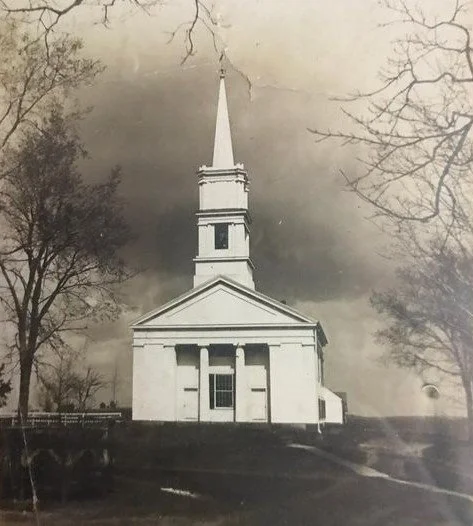
The edifice eventually became inadequate, and in 1845, after months of discussion, a company of fourteen men contracted to move it to where it now stands, add a vestibule and raise it a story, so that a small vestry, town hall, and selectmen’s room could be built underneath. It was turned to face west.
In 1869, the church bell now in use, weighing 1500 pounds, was hung. It replaced a 700-pound bell installed in 1818, which was cracked by the village blacksmith sounding the alarm for a fire.
The steeple erected in 1845 was damaged by high winds in 1934 and blown down again during the hurricane of 1938. The present steeple was erected in 1941.
The church was at first operated by the town and supported by taxes. It slowly developed independence and in 1887 became a fully incorporated body under state law. Separation of town and church became complete when in 1954 the town voted “to deed all rights and interests which it held in the church building to the Evangelical Congregational Church, also the land on which it stands.” The town has now also deeded the bell to the church.